Published 25th Mar 2026 | By James Lawley
Est. reading time: 5 mins read

What’s the Difference Between Generative AI and Agentic AI?
Published 25th Mar 2026 | By James Lawley
Est. reading time: 5 mins read
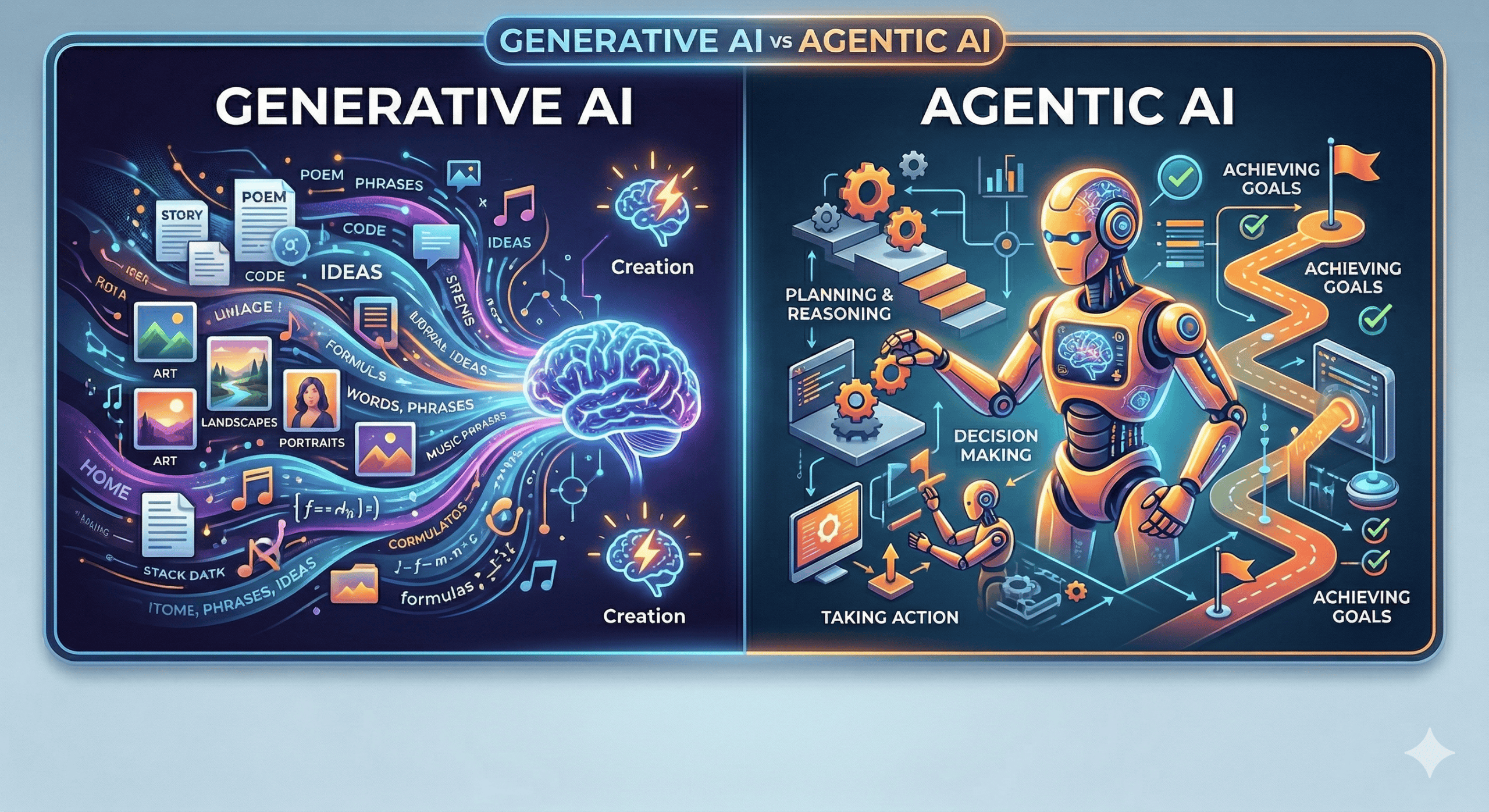
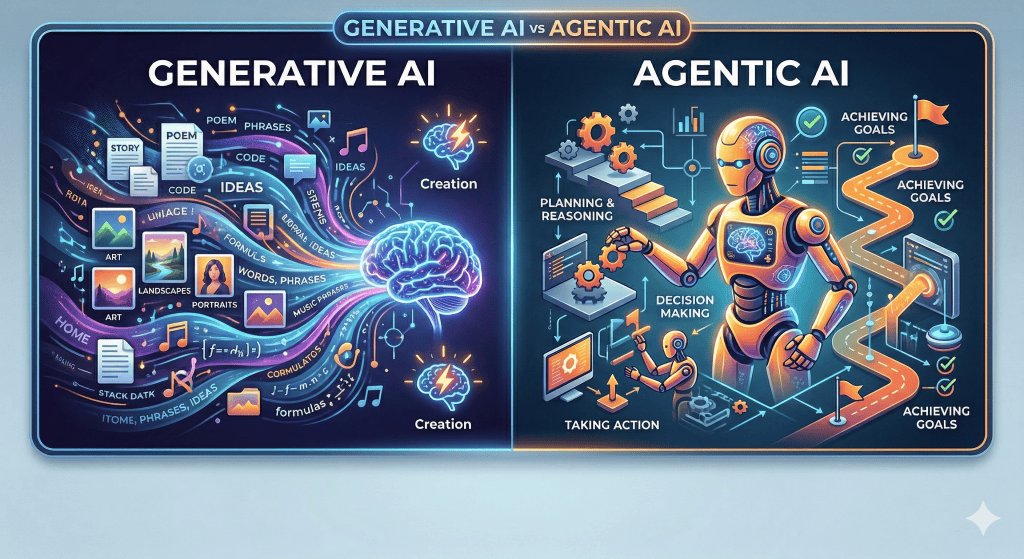
TL;DR: Generative AI produces content when you ask it to. Agentic AI takes a goal and acts on it independently, making decisions, using tools, and completing multi-step tasks without you having to direct every move.
If you’ve been following the AI conversation over the past couple of years, you’ll have heard plenty about generative AI. ChatGPT, image generators, AI copywriting tools. These platforms have dominated the headlines and, for many marketing teams, transformed how content gets produced. But a new term is creeping into boardroom conversations and agency briefs: agentic AI. And for marketing decision-makers and business owners, understanding the difference between the two isn’t just academically interesting, it could define whether your business keeps pace or falls behind.
Generative AI: The Smart Assistant That Waits to Be Asked
Think of generative AI as an exceptionally talented member of staff who only works when you give them a specific instruction. You ask, they produce, and then they stop. It’s reactive by nature.
When you prompt a generative AI tool to write a product description, summarise a report, or draft a social media caption, it does so remarkably well. It synthesises information, mirrors tone of voice, and works at a speed no human could match. That’s genuinely valuable, and it’s why businesses have rushed to adopt it.
But here’s the catch: generative AI has no awareness of what comes next. It doesn’t know what to do with the content once it’s created. It won’t send that email, update your CRM, publish to your website, or flag a performance issue in your ad account. Once it’s handed over its output, the baton passes back to you. Every step of the journey still requires a human to pick it up, move it along, and hand it to the next person or platform.
For agencies and marketing teams, this means generative AI accelerates individual tasks without necessarily making the broader workflow any more efficient. You’re still managing all the handoffs, the data transfers, and the manual decision-making that sit between one task and the next.



Agentic AI: The System That Gets On With It
Agentic AI is a fundamentally different proposition. Rather than waiting for a prompt and producing a single output, an agentic system receives a high-level objective and figures out how to achieve it by breaking the goal down into steps, taking actions across multiple platforms, adjusting when things go wrong, and continuing until the job is done.
Where generative AI is reactive, agentic AI is proactive. Where generative AI creates content, agentic AI executes outcomes.
Consider a practical example. Imagine a client’s paid media campaign begins underperforming, cost per acquisition spikes and click-through rates drop. A generative AI tool might help you draft a report about it, if you ask. An agentic AI system would detect the issue itself, diagnose the likely cause, pause the underperforming ad, generate new creative, push it live to the platform, reallocate the budget accordingly, and notify the account manager. All without a human lifting a finger.
That’s not a minor efficiency gain. That’s a wholesale change to how work gets done.
Why It Matters for Your Business Right Now
The market figures here are difficult to ignore. The global market for AI agents is expected to grow at around 45% annually, potentially reaching £60 billion by 2030. Enterprise adoption is accelerating at over 125% year-on-year. By 2028, a third of all enterprise software is predicted to have agentic AI capabilities built in, compared to less than 1% today.
For marketing decision-makers, this trajectory means two things. First, the agencies and in-house teams that get ahead of this shift will be able to handle more clients, more campaigns, and more complexity without proportionally growing their headcount. Second, those who don’t will find themselves undercut on both speed and price by competitors running leaner, more automated operations.
The Practical Difference in a Marketing Context
Generative AI has already changed content production. A copywriter who once spent a day drafting ad variations can now do it in an hour. That’s real value.
But agentic AI tackles an entirely different problem: the inefficiency that lives between tasks. The time spent moving data from one platform to another. The delay between a lead coming in and a salesperson being notified. The hours a performance manager spends manually checking dashboards that could be monitored automatically. The SEO workflow that involves bouncing between five different tools before a single article goes live.
Agentic systems can own entire processes end to end, from keyword research through to CMS publishing, post-publication monitoring, and internal reporting. All without a human directing every step.
Getting the Balance Right
None of this means handing over the keys entirely. The smart approach is to think carefully about where automation can operate independently and where human judgement is still essential.
A useful way to think about it is in terms of delegation levels. Some tasks are fine for an AI to draft and a human to approve. Others can be fully automated with human oversight after the fact. And a handful of high-stakes decisions, client communications, brand positioning, legal compliance should always sit with a person.
The danger isn’t deploying AI too ambitiously. It’s deploying it without thinking through the guardrails. An unchecked agentic system with broad permissions could overspend a budget, publish something off-brand, or make changes across platforms before anyone notices. Governance, clear boundaries, and audit trails aren’t optional extras, they’re what make the whole thing work safely.
The Bottom Line
Generative AI gave us faster content. Agentic AI gives us something far more significant: the ability to run complex, multi-step marketing operations continuously, intelligently, and largely without manual intervention.
For business owners and marketing leaders, the question is no longer whether AI will change how your agency or team operates. It already has. The question now is whether you understand the difference between a tool that helps you write faster and a system that can actually run the work and whether you’re positioning your business accordingly.
The organisations that grasp this distinction first won’t just be more efficient. They’ll be operating at a level their competitors simply can’t replicate without making the same shift.
Connect with us …