Published 10th Mar 2026 | By James Lawley
Est. reading time: 4 mins read

From Keywords to Conversations (2000–2026)
Published 10th Mar 2026 | By James Lawley
Est. reading time: 4 mins read
The Evolution of Search
If you’ve been in business for more than a decade, you’ll remember when SEO was essentially a game of hide and seek. You hid keywords, and Google sought them out. Today, that game has been replaced by a sophisticated, AI-driven conversation.
To stay visible in 2026, you have to understand the journey from the Wild West to the new frontier of AISO (AI Search Optimisation).
2000–2010: The Wild West & The Era of Manipulation
In the early days, Google was a relatively simple indexing machine. It looked for exact matches. If you wanted to rank for London Accountant, you just needed to ensure those two words appeared more times than your competitors’. This led to an era of gaming the system with techniques that would get you permanently banned today.
The Black Hat Hall of Shame (Avoid these at all costs):
- Keyword Stuffing: Blocks of nonsensical text designed only for bots.
- Invisible Text: Writing keywords in white text on a white background.
- Doorway Pages: Poor-quality pages created solely to trap search traffic and redirect it elsewhere.
- Link Farming: Buying thousands of backlinks from dodgy sites to trick Google into thinking you were popular.
- Scraper Sites: Automatically stealing content from other sites to fill up your own.

2011–2019: The Quality Revolution (Strings to Things)
Core Web Vitals: Measuring the Feel of a Site
Google introduced a set of specific metrics called Core Web Vitals. These weren’t just about raw server speed; they measured how a user perceived the page loading. If your site “jumped around” while loading or took too long to become clickable, Google began pushing you down the rankings.
- LCP (Largest Contentful Paint): This measures Loading Performance. It marks the point when the main content of a page has likely loaded. In simple terms: how long does it take for the user to see the “meat” of the page?
- FID (First Input Delay): This measures Interactivity. It tracks the time from when a user first interacts with your site (clicking a button or a link) to the time the browser actually begins processing that interaction.
- CLS (Cumulative Layout Shift): This measures Visual Stability. Have you ever tried to click a link, but the page shifted at the last second and you clicked an ad instead? That is a poor CLS score, and Google started penalizing sites for it.
BERT & MUM: Understanding Human Nuance
While the technical team was focusing on speed, Google’s AI team was teaching the search engine how to actually “read” like a human.
- BERT (Bidirectional Encoder Representations from Transformers): Launched in late 2019 but dominating the early 2020s, BERT allowed Google to understand the intent behind a search. It started looking at the words before and after a keyword to understand context. For example, it learned the difference between “stand” (to get up) and “stand” (a fruit stand).
- MUM (Multitask Unified Model): Introduced in 2021, MUM was 1,000 times more powerful than BERT. It didn’t just understand text; it understood images and video too. MUM was designed to solve complex queries that didn’t have a simple answer, often pulling information across multiple languages to provide a comprehensive result.
The Shift to Helpful Content
This culminated in the Helpful Content Update. Google made it clear: if you are writing for search engines (keyword stuffing), you will fail. If you are writing to genuinely help a human, you will win. This was the final nail in the coffin for “SEO-only” copywriters. Content had to be original, deeply researched, and technically flawless.
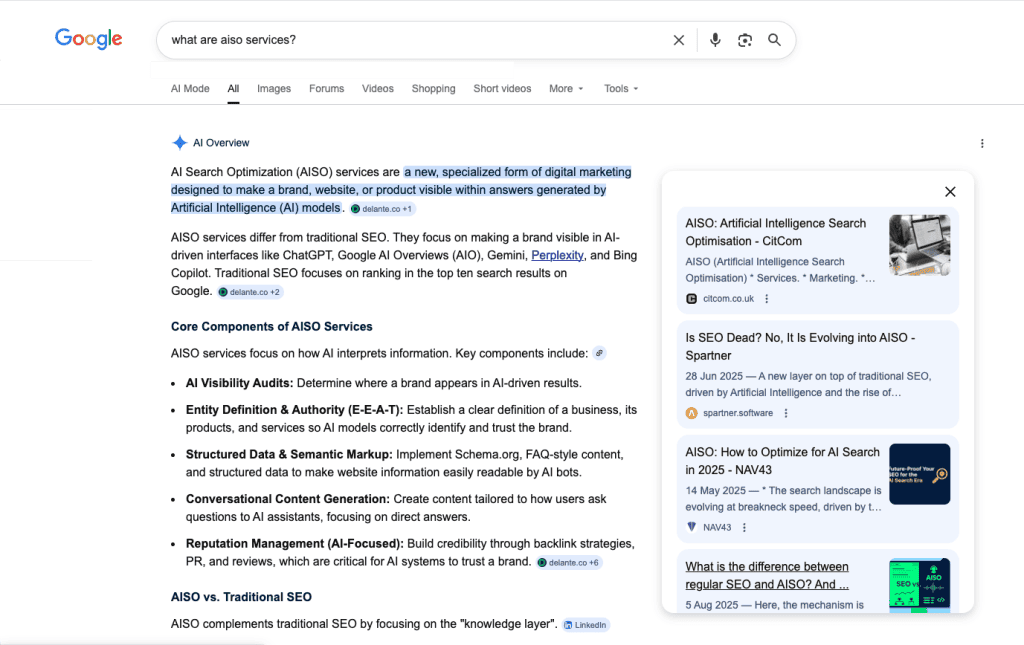
2025–2026: The New Frontier – AISO & Agentic Search
Welcome to the present. We are no longer just optimising for a list of ten blue links. We are optimising for AI Overviews (SGE), ChatGPT Search, and Microsoft Copilot.
This is the era of AISO (AI Search Optimisation). Here’s how the landscape has fundamentally changed:
The Zero-Click Reality
In 2026, many users never actually visit a website. The AI bot reads the web, finds the best answer, and summarises it for the user right on the search page.
- The Goal: You don’t just want to be a link; you want to be the cited source that the AI uses to build its answer.
From Clicks to Conversations
People treat search engines like companions now. Queries are longer and more conversational (e.g., Find me a sustainable architect in the UK who specialises in timber frames and has won awards in the last two years).
- The Strategy: We optimise for long-tail intent. We ensure your site is structured so an AI bot can ingest your expertise and recommend you.
E-E-A-T as a Shield
With AI now able to generate billions of pages of content instantly, the internet is flooded with fluff. Google’s response is E-E-A-T (Experience, Expertise, Authoritativeness, and Trustworthiness).
- The Key: Demonstrating real human experience (case studies, original photos, expert bios) is now the only way to prove to an AI that you aren’t just a bot-generated farm.
Machine-Readable Data (AISO)
In 2026, your Technical SEO isn’t just about speed; it’s about Schema Markup. This is the hidden code that tells an AI bot exactly what your data means. If the bot can’t understand your pricing, your team, or your services at a code level, it will skip you for a competitor who is machine-readable
The Verdict: Don’t Get Left in 2010
SEO hasn’t died; it has simply evolved from a manual task into a high-tech discipline. If you are still focusing on keyword density, you are invisible to the AI bots that now control 2026’s traffic.
Is your website machine-readable? The transition to AISO is the single biggest change in the history of the internet. At CitCom, we specialise in moving brands from the keyword era into the AI-driven future.
Connect with us …