Published 13th Jul 2026 | By Ciaran Pillay
Est. reading time: 8 mins read

How World Events Are Shaping the Future of AI Search
Published 13th Jul 2026 | By Ciaran Pillay
Est. reading time: 8 mins read
AI search is set to be shaped more by community protests, planning battles, and governmental shifts than consumer behaviour. Here’s a look at the key contributing factors.
In a previous piece, I wrote about the Rule of 25, the idea that modern consumers need somewhere between 25 and 30 brand touchpoints before they’ll commit. A key part of that argument rested on the rise of AI-curated feeds and the collapse of the traditional search click as a reliable discovery mechanism. Since I published that piece, the pace of change has accelerated considerably. So consider this a field update.
AI Search Optimisation (AISO) is no longer a forward-looking discipline. It is a current operational reality. But exactly where it lands, what it looks like in five years, and whether the infrastructure required to sustain it is even politically viable? That’s a considerably murkier picture. Let me walk through where things stand.
The Consumer Has Already Moved
Before we get into the big corporate announcements and the planning battles in small American & UK towns, it’s worth anchoring this in actual behaviour, because the numbers are stark.
According to SparkToro’s 2026 research, 68% of Google searches now end without a single click to any external website. That’s up from 60% in 2024. When an AI Overview is present, which now triggers on roughly a quarter of all queries, that zero-click rate climbs to 83%. And for searches conducted in Google’s newer AI Mode? Semrush puts the zero-click rate at 93%.
Think about that for a moment. Nine out of ten searches in AI Mode produce no outbound click whatsoever.
Bain & Company’s consumer research from early 2025 put it plainly: 80% of consumers now rely on AI-generated results for at least 40% of their searches, and organic web traffic has declined an estimated 15–25% across many sectors as a direct result.
The search results page is no longer a gateway. For a growing majority of queries, it is the destination.
This matters enormously for how brands need to think about visibility. Ranking at position one no longer guarantees traffic, if the AI answers the question before the user sees your listing, position one is just a citation footnote. The game has shifted from rank to being the answer. That’s the fundamental premise of AISO, and it’s not a niche SEO concern anymore. It’s a business model concern.
What Google Said in May
If the consumer data gives you the ‘what,’ Google’s developer conference and Google Marketing Live EMEA gave us the clearest picture yet of the ‘where.’
At Google I/O in May 2026, the company described what it called the biggest change to Search in over 25 years. The traditional search box has been reimagined as an AI-first interface. Instead of returning a ranked list of blue links, Google Search now builds custom, generative responses: interactive layouts, dynamic visualisations, and conversational follow-ups, entirely on the fly, powered by Gemini 3.5 Flash.
The company also announced information agents: autonomous tools that can be instructed to monitor topics, track listings, and notify users when specific conditions are met: all operating in the background, with or without the user actively engaging. This is the agentic layer that sits underneath modern search. AI is no longer just finding things. It is doing things on behalf of the user.
For marketers, the EMEA Google Marketing Live summary confirmed the commercial direction of travel. Four clear priorities emerged:
- AI as a discovery engine: Google is positioning AI Overviews and AI Mode not as a degradation of search, but as an upgrade, capturing “high-value intent earlier than ever.” The language is confident, even bullish.
- Demand Gen on YouTube: The expansion of AI-driven audience prediction across Search, Maps, and YouTube signals a world where Google’s systems are increasingly making placement decisions, not media buyers.
- Agentic Commerce: Google’s term for removing friction between discovery and purchase. Turning “curiosity into checkout” in a single, unbroken AI-driven flow. For retailers, this is both an opportunity and a threat to owned-channel relationships.
- Data Strength as the foundation: Google was explicit that brands who feed their own data into Google’s AI (via the Google tag gateway, Merchant Center, and Meridian) will compound advantage over those who don’t. The message was clear: the brands that share their data most completely will be amplified most powerfully.
TechCrunch called it plainly: Google Search as you know it is over. That’s a headline designed to generate traffic, but it’s not wrong. The traditional architecture of search: query in, ranked links out, user clicks through, is being systematically dismantled and rebuilt around conversational AI interfaces.
The Infrastructure Problem Nobody Wants to Talk About
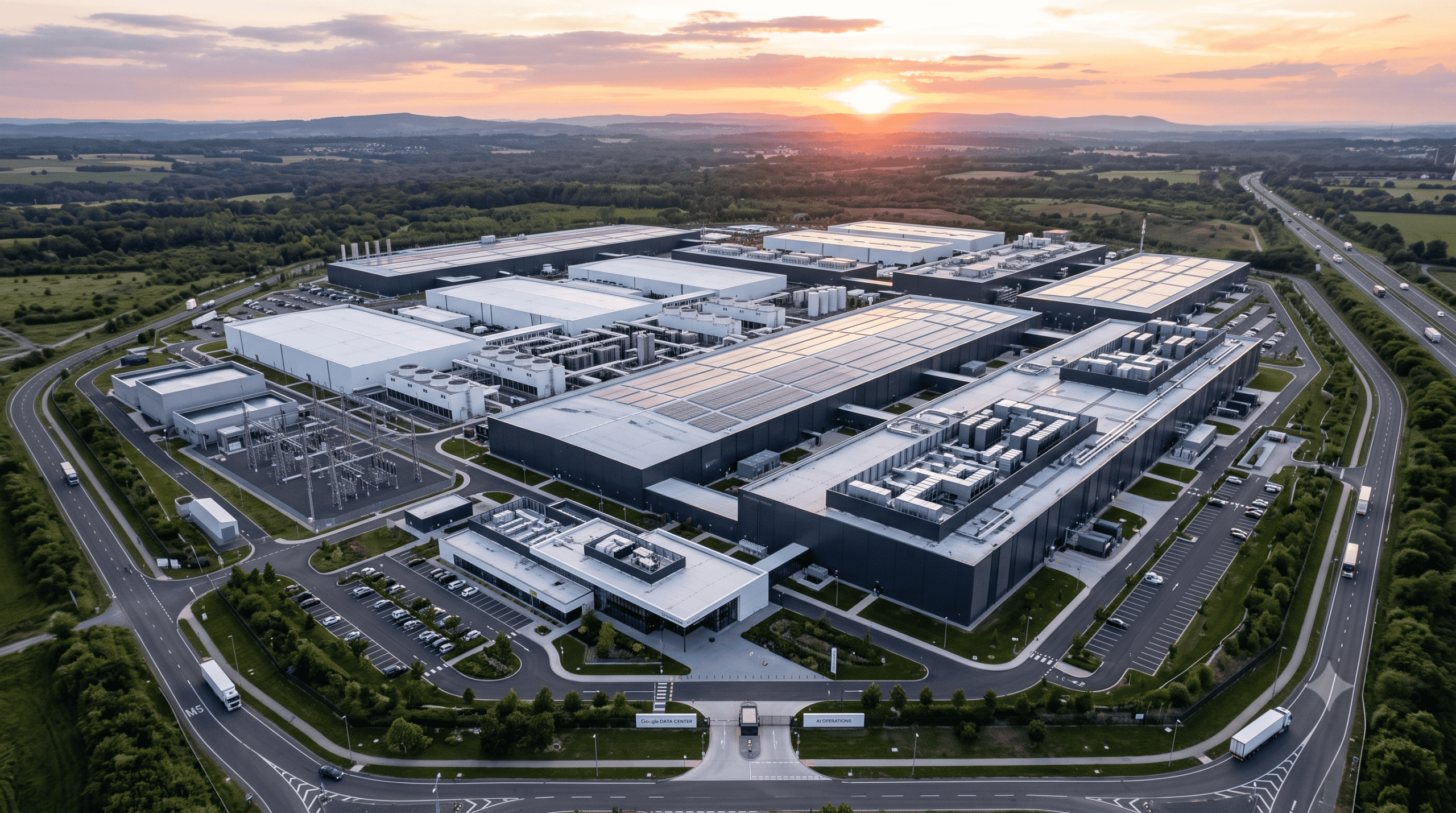
All of this AI – every Gemini response, every AI Overview, every background information agent – requires physical infrastructure on a scale that is beginning to generate serious political friction, on both sides of the Atlantic.
In America, the numbers are stark. There are more than 5,400 data centres in the US, with a further 3,000 planned or under construction. More than $64 billion in projects were delayed or cancelled between May 2024 and March 2025 due to organised local opposition. A Gallup poll from early 2026 found that 71% of Americans oppose a data centre being built in their area, a figure that now exceeds peak opposition to nuclear power plants. The objections are cross-partisan and, increasingly, legally durable.
The UK is at an earlier stage of the same tension, but the trajectory is clear. Planning applications for data centre developments in England doubled between 2024 and 2025. The government has repeatedly overturned local council rejections to greenlight large-scale developments, including on green belt land, and has made it easier for developers to sidestep councils entirely via Development Consent Orders. Communities, predictably, are pushing back. In North Ockendon, residents are fighting a proposed 215-hectare site. In Brick Lane, a proposal to replace one of East London’s most historically layered cultural sites with a data centre has drawn fierce opposition, with critics calling it not development but “extraction.” Research by engineering consultancy Hoare Lea found that “inadequate community engagement” was the single biggest driver of planning delays, with average consent timelines running at 18 months.
Greater Manchester has been actively positioning itself as a data centre hub – KAO Data’s £350 million facility in Stockport, due in 2027, will run on 100% renewable energy, and Manchester has been ranked the UK’s most AI-ready city for two consecutive years. But the Greater Manchester Combined Authority has itself acknowledged that genuine local benefit requires “specific measures to connect data centres with regional supply chains and create social value,” rather than simply appearing in a postcode.
Which raises an interesting question for whoever walks into Downing Street next. Andy Burnham’s team has already signalled a meaningful shift: “we do need data centres, but we need to think about who runs and owns them, there has to be a framework for accountability.” One insider close to his AI plans described the previous government’s approach to US tech investment as a “geopolitical failure that hasn’t delivered on its intended aims” and had put Labour “at odds with its voters.” Burnham’s politics – rooted in devolution, public services, and the belief that infrastructure should be felt in people’s lives – suggests his question will be a sharper one: growth where, exactly, and for whom? Whether that translates into a serious policy position on data centre ownership and community benefit, or remains a background concern managed by planning reform, will be telling.
The core question for the AI search sector remains: can the physical infrastructure required to sustain these systems be built at the pace the tech giants need? And if the political cost becomes prohibitive – here as much as in America – what does that mean for the timeline of everything Google announced in May?
So Where Does This Leave Us?
Honestly? In a genuinely uncertain place, which I think is the only responsible conclusion to draw.
The consumer behaviour shift is real and accelerating. The technology is advancing rapidly. Google’s direction of travel is unmistakable: the company is betting its entire business model on AI-mediated search, and it’s committing capital accordingly (Alphabet expects to spend between $180 billion and $190 billion on capex by the end of the year). The marketing infrastructure: AISO, GEO, AEO, whatever acronym you prefer, is not a fad. It is the emerging discipline of digital visibility in an AI-first world.
But the physical constraints are real too. You cannot run AI at civilisation-scale on goodwill and planning permissions. The opposition to data centre construction has moved well beyond local NIMBY dynamics, it is now a structural political and regulatory risk, with bipartisan support, litigation in multiple states, and federal-level scrutiny beginning to develop.
Whether that friction slows the rollout of AI search meaningfully, forces the tech sector to invest more heavily in renewable energy and genuinely community-compatible siting, or simply gets steamrolled by the sheer weight of capital behind it, that remains an open question.
What I’m watching: how quickly AI Mode rolls out in Europe (Google is currently in regulatory discussions with the EU over the AI Act’s implications); how the energy cost question plays out politically in the US midterms; and whether any serious alternative to Google’s AI search hegemony – Perplexity, ChatGPT Search – develops enough scale to meaningfully fragment the market.
My working assumption for our clients, for now: optimise for the world that exists, not the one that might arrive. The zero-click era is here. AI Overviews are reducing organic CTR by more than 58%. Being cited by an AI system is already more commercially valuable for many queries than ranking at position one. The AISO fundamentals: structured content, authority signals, original data, strong technical foundations, and genuine presence across a diverse ecosystem of touchpoints, remain sound regardless of which platform ultimately dominates.
The direction is clear. The destination is still being negotiated.
Interested in how AISO fits into your digital strategy? Talk to us about how CitCom approaches AI-era visibility.
Connect with us …